
Private Payrolls Rise by 98,000 in June 2026: Job Growth Slightly Below Expectations

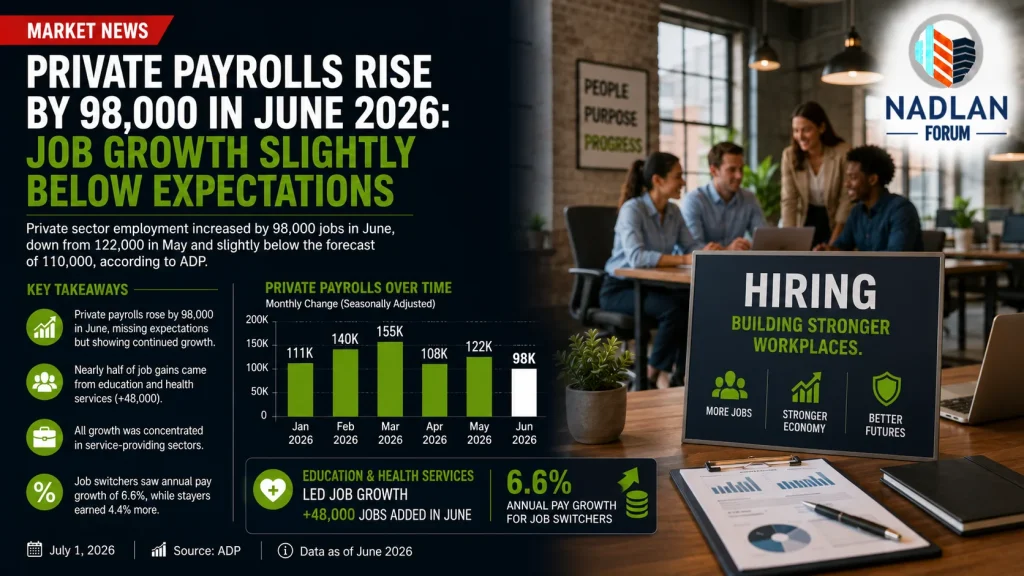
Private sector employment in the U.S. grew by a seasonally adjusted 98,000 jobs in June 2026, according to data released by payroll processor ADP. The figure was down from 122,000 in May and slightly below the consensus forecast of 110,000.
The report highlights a moderation in job growth, though employment gains remain concentrated in key service-oriented sectors.
Sector Highlights
Nearly half of the new jobs in June 48,000 positions came from the education and health services sector, which has consistently been a leading contributor to payroll growth. Overall, nearly all gains were within service industries, with only minimal expansion in other sectors.
Other notable sector performance included:
- Trade, transportation, and utilities: +15,000
- Financial activities: +14,000
- Other services: +8,000
- Leisure and hospitality: +2,000
- Natural resources and mining: -5,000 (only sector with job losses)
This distribution reflects targeted hiring toward stable service sectors, while cyclical and consumer-sensitive areas remain more subdued.
Payroll Gains by Business Size
Hiring was skewed toward smaller businesses in June:
- Fewer than 50 employees: +53,000 jobs
- Employers with 50–499 employees: +29,000 jobs
- Large businesses (500+ employees): +25,000 jobs
Smaller establishments continue to be the primary engine of job creation, contributing over half of the total payroll growth for the month.
Wage Growth and Job Switchers
Annual pay gains remained steady for current employees at 4.4%, while employees who switched jobs saw an increase of 6.6%, suggesting mobility continues to reward workers seeking higher compensation.
Moderate wage growth across the private sector aligns with slower payroll gains and reflects ongoing labor supply constraints in certain industries.
Implications for Labor Market
ADP Chief Economist Nela Richardson commented that June’s hiring pace tells a story of both labor demand and supply constraints:
“We know it’s taking people longer to find work, but there are also signs of labor supply constraints in certain industries. For now, the overall effect is a slowdown in job creation.”
The data points to a labor market that remains tight in some sectors while overall expansion is moderating, a trend consistent with broader economic conditions in mid-2026.
Preview of Government Nonfarm Payrolls
The ADP report is typically seen as a precursor to the official nonfarm payrolls data, which is released by the U.S. Bureau of Labor Statistics.
For June, Wall Street expectations anticipate:
- Nonfarm payroll growth: +115,000
- Unemployment rate: steady at 4.3%
- Average hourly earnings: +0.3% monthly, +3.5% annually
Investors and policymakers closely watch these indicators for guidance on economic momentum, inflationary pressures, and potential Federal Reserve policy adjustments.
Final Thoughts
June’s private payroll increase of 98,000 reflects slightly slower growth than anticipated, with hiring heavily concentrated in education, health services, and small businesses. Wage gains remain moderate, and labor supply constraints may continue to influence sector-specific hiring.
The ADP data sets the stage for the government’s official employment report, which will provide a more comprehensive view of U.S. job market dynamics in June 2026 and guide economic forecasts and policy decisions for the coming months. For direct financing consultations or mortgage options for you visit 👉 Nadlan Capital Group.

























Responses