
Jobs Report and Stock Declines Keep Mortgage Rates Locked in a Tight Range

This week brought back some of the key economic data that had been delayed by the recent government shutdown. One of the biggest releases was the long-awaited September jobs report, which finally arrived and had an immediate impact on the bond market. Even though the numbers were a little dated, the report triggered the strongest trading volume in bonds since the last Federal Reserve meeting a reminder of how influential the monthly jobs report is compared with most other economic data.
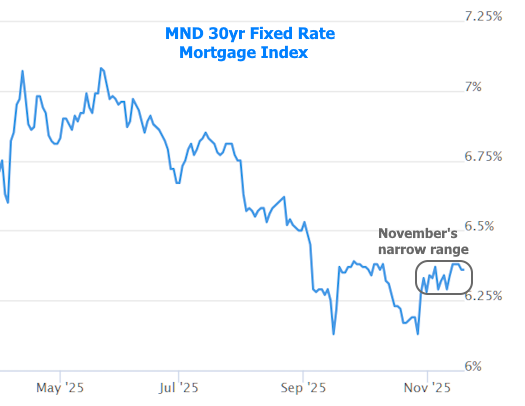
Despite the surge in activity, mortgage rates didn’t move much. Instead, rates stayed locked in the same narrow pattern they’ve been following for weeks. The lack of movement came down to one thing: mixed signals inside the jobs report itself.
Jobs Report Delivers Conflicting Signals
The payrolls portion of the report showed solid job creation. Employers added 119,000 jobs, far above the 50,000 economists had expected. But that good news was offset when the prior month’s numbers were revised sharply lower from a gain of 22,000 jobs to a loss of 4,000.
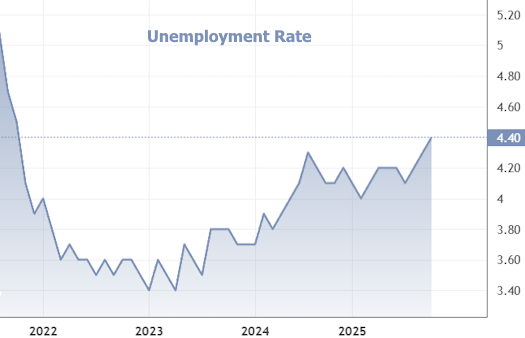
The other half of the jobs report the household survey was just as mixed. This survey determines the unemployment rate, which rose to 4.4% from 4.3%, marking the highest reading of the current cycle and slightly above what analysts predicted.
Normally, a rise in unemployment would push rates lower, but there was an important detail behind the increase: the labor force participation rate also rose by 0.1%. That means more people started looking for work. When participation rises while job openings stay steady, the unemployment rate can tick higher even if conditions haven’t worsened. Because of this, markets saw the increase in unemployment as softer not as alarming as it would have been without the participation gain.
Even with the mixed signals, the overall tone leaned slightly positive for interest rates, helping keep mortgage rates from drifting higher.
Stock Market Slide Supports Bonds and Interest Rates
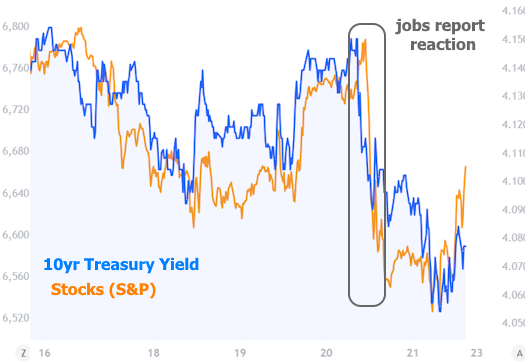
A second major influence this week was the continued weakness in stocks. Although stock prices and interest rates don’t always move together, significant stock losses often push money into safer assets like government bonds. When that happens, bond prices rise and yields fall, which helps mortgage rates ease.
That pattern played out again this week. Bonds strengthened whenever stocks declined, putting light downward pressure on rates. But just as the jobs report sent mixed signals, stocks reversed course at times, preventing bond yields from making a meaningful break lower.
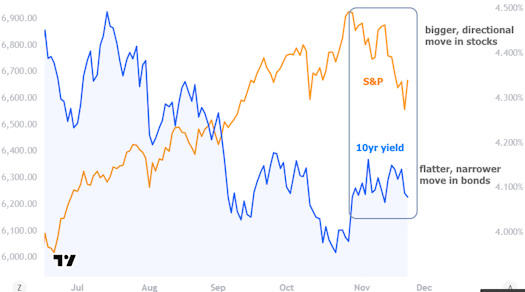
A broader look at recent market trends shows this clearly:
- Stocks have been in a noticeable correction for several weeks.
- Bonds, meanwhile, are still stuck in a tight, sideways range with little momentum in either direction.
- Mortgage rates continue to follow that same narrow pattern moving slightly but staying within the same boundaries.
Rates Still Waiting for a Clear Direction
Looking ahead, mortgage rates will need more reliable economic data to break out of this holding pattern. That could be tough in the near term. Several important reports delayed by the shutdown are still being rescheduled, meaning markets won’t get the usual flow of information they rely on.
Most importantly, the most influential reports such as inflation data will not come in before the Federal Reserve’s December 10th meeting. That leaves the Fed with less information than usual, which makes the upcoming policy decision far less predictable.
With uncertainty running high, the December meeting could bring more volatility than normal. For the first time in many months, the Fed’s next move a rate cut or a pause truly could go either way.
Until then, mortgage rates are likely to stay in the same familiar range, waiting for stronger signals from the economy or the Fed. For direct financing consultations or mortgage options for you visit 👉 Nadlan Capital Group.



















Responses