
America’s Housing Shortage: A Deeper Dive into the Missing Homes


A new, granular national analysis reveals a housing shortfall of nearly two million homes across the United States. The study, titled Bringing the Housing Shortage Into Sharper Focus, is a collaboration between PolicyMap, Moody’s Analytics, and the Urban Institute. It utilizes detailed census tract data from nearly 350 U.S. cities with populations exceeding 100,000, providing a deep dive into the supply and demand for housing at a localized level.
This focused study offers crucial insights into the specific locations and types of homes that are most needed, revealing disparities between neighborhoods that were previously obscured by broad national estimates. According to Maggie McCullough, CEO and Founder of PolicyMap, “Understanding this data with this level of granularity is vital. It not only shows how many homes are missing but also where they’re most needed, whether for renters or homeowners, and which income groups are most affected.”
A Detailed Analysis of the Housing Deficit
While previous studies have provided wide-ranging national estimates of housing shortages—ranging from 1.5 million to over seven million homes this report breaks the issue down in far more detail. The analysis compares current vacancy rates against a stable baseline from 2012 to 2018, a period prior to the disruptions caused by the COVID-19 pandemic. This allows for a more precise understanding of where the housing deficits are most severe and whether the shortage is in rental properties or homes for sale.
Key Takeaways from the Report
- Deepest Shortfalls in Moderate to Middle-Income Rental Markets: These areas, which the report refers to as “workforce rental” housing, are experiencing the most significant shortages. There’s a marked gap in affordable rental units, especially in areas where working-class populations are struggling to find homes within their price range.
- High-Income Areas Have Rental Surpluses: In contrast, high-income neighborhoods, particularly in large cities, are often oversupplied with rental properties. This imbalance creates a disconnect between the supply of rental units and the actual demand from lower and moderate-income renters.
- The Ownership Market Is More Balanced: Overall, the ownership market is more balanced than the rental market, though some high-income areas remain tight, and some lower-income neighborhoods even show small surpluses of homes for sale.
- National Housing Shortage Driven by Rental Deficits: The national housing shortage is primarily due to a lack of rental housing rather than homes for sale. This disparity is contributing to the increasing unaffordability of housing, particularly for those in lower and middle-income brackets.
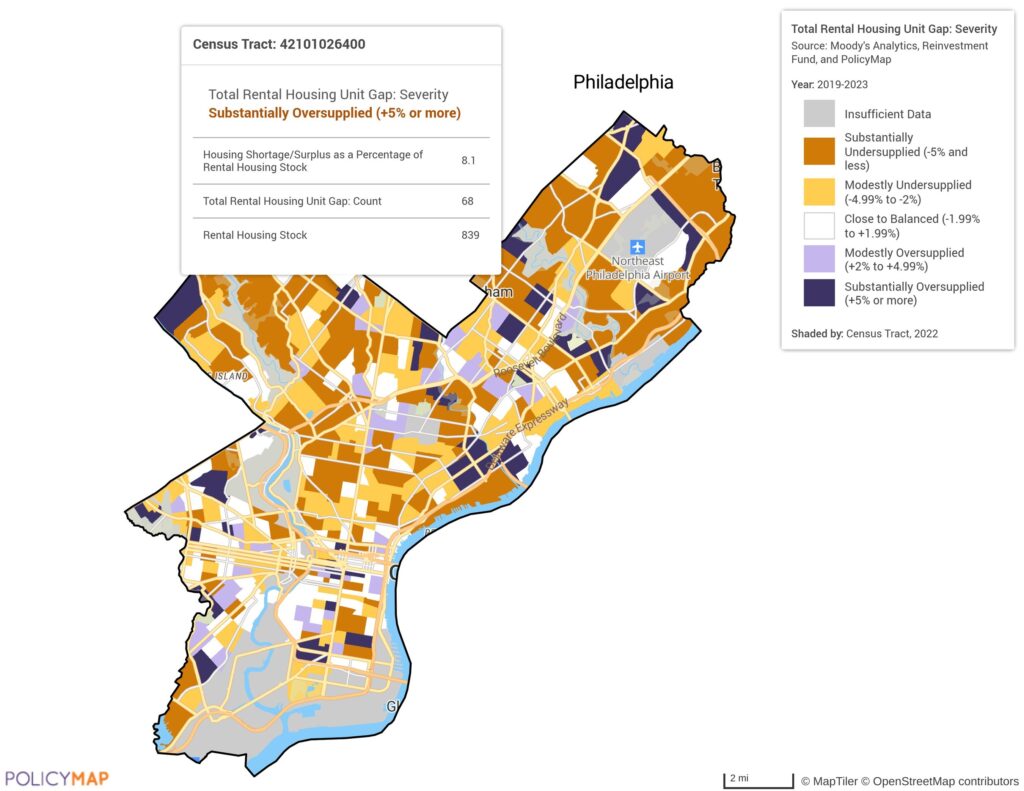
- Neighborhood-Level Imbalances: While many cities might appear balanced in terms of housing supply and demand at the metropolitan level, this study uncovers neighborhood-level imbalances that are often hidden when aggregated data is used.
Implications for Policymakers and Investors
Cristian deRitis, Deputy Chief Economist at Moody’s Analytics, emphasizes that housing supply is not a one-size-fits-all issue. He states, “You can’t solve affordability by adding units in the wrong places.” The analysis highlights how local mismatches between supply and demand distort the broader housing market. By using detailed, census tract-level data, the study provides policymakers with a more targeted, data-driven approach to solving the housing crisis.
This report’s ability to update annually with fresh data from the American Community Survey (ACS) offers a dynamic, evolving picture of housing needs. As McCullough points out, “This wasn’t designed to be a report that sits on a shelf.” Communities now have access to real-time data that they can use to take immediate action.
Why Broad Policies Often Miss the Mark
The study clearly illustrates why national policies can fall short in addressing housing shortages effectively. Traditional estimates that aggregate data at the city, state, or regional level obscure the real challenges faced by local communities. As Ira Goldstein, Senior Advisor of Policy Solutions at Reinvestment Fund, explains, “Families are not indifferent to price, tenure, and neighborhood, and these data help policymakers and investors better understand and meet the needs.”
Moving Forward
This in-depth analysis offers much-needed clarity and actionable insights for addressing America’s housing crisis. By pinpointing exactly where the shortages lie, whether in rental properties or homes for sale, and who is most affected, it provides a roadmap for more effective housing policies and investments. With the ability to track shifts in the housing landscape year by year, this study equips communities and policymakers with the tools they need to meet the evolving needs of their populations and drive lasting solutions to the housing affordability crisis. For direct financing consultations or mortgage options for you visit 👉 Nadlan Capital Group.




























Responses