
Home Flipping Profits Drop Amid Rising Costs and Tightening Margins


The home-flipping market has shown signs of strain, as rising home prices and increased acquisition costs have squeezed profit margins. According to ATTOM’s Q2 2025 U.S. Home Flipping Report, approximately 78,621 homes were flipped during the second quarter, accounting for 7.4% of all home sales from April to June. This is a slight decrease from both the previous quarter and the same period in 2024, continuing a seasonal trend where flipping activity is generally higher in the first quarter when sales volume is lower.
Profit Margins See Historic Decline
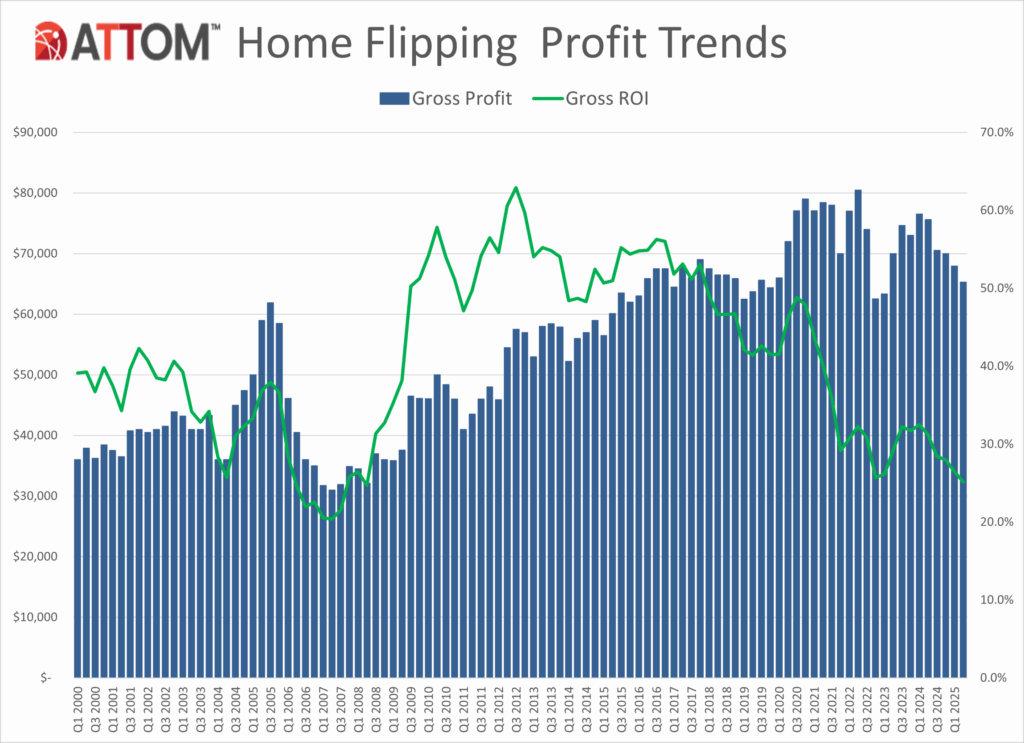
The second-quarter 2025 report highlights a significant drop in profitability for home flippers. The average return on investment (ROI) for flipped properties stood at 25.1%—a far cry from the 62.9% return seen in 2012, and the lowest margin since Q2 2008. This decline is largely driven by escalating property prices, which have increased the initial buy-in cost for potential flippers, particularly for homes in need of renovation. While flipping homes can still offer profitable returns, the financial cushion has shrunk considerably.
The gross profit from flipping homes also saw a downturn, with the typical profit decreasing by 4% from the previous quarter and falling 13.6% from the same period last year. The average gross profit from a flipped home dropped to $65,300, down from $75,000 in Q2 2024. These statistics signal a challenging landscape for investors in the house-flipping business.
The Impact of Rising Home Prices
In Q2 of 2025, home flippers paid an average of $259,700 for homes, marking the highest median purchase price recorded since ATTOM began tracking the data in 2000. Despite these higher acquisition prices, the median sales price for flipped properties held steady at $325,000. This pricing imbalance has made it harder for flippers to generate substantial returns, as they are forced to pay more for properties that may not appreciate quickly enough to offset the costs involved.
“The high initial purchase prices, coupled with the ongoing competitive nature of the housing market, have made it difficult for flippers to find homes that can yield substantial returns,” said Rob Barber, CEO of ATTOM. “As prospective homeowners increasingly get priced out of higher-value markets, flippers are now often competing with these buyers for the same homes.”
Regional Markets Show Variance in Home Flipping Activity
Despite these national trends, home flipping activity has remained more resilient in certain regions, where high demand and increased inventory levels are still fueling profitability for flippers. In particular, cities in Georgia such as Warner Robins, Macon, and Atlanta saw the highest rates of flipping activity in Q2 2025, with Warner Robins leading the charge at 18.5% of total home sales. Other cities like Memphis, TN, and Birmingham, AL also saw significant levels of home flipping.
Conversely, markets like Seattle, Boston, and Portland reported some of the lowest rates of home flipping, with Seattle’s flipped homes accounting for only 4.1% of total sales. These areas, often characterized by expensive real estate and slower property turnover, show less favorable conditions for home flippers.

The Role of Cash Buyers and Time-to-Flip Trends
A notable trend in the second quarter was the increased reliance on cash transactions. Approximately 62.6% of flipped homes were purchased with cash in Q2 2025, slightly up from 62.3% in Q1 of the same year. This preference for cash deals can be attributed to the increased difficulty of securing traditional financing in a market with rising acquisition costs and a relatively uncertain economic environment. Cash offers allow flippers to expedite their purchases and avoid delays caused by loan processing.
Additionally, the average time it took to flip a home in Q2 of 2025 was 165 days, a slight improvement from the 167 days observed the previous year, but still a notable increase from the 163 days in Q1 2025. This increase in time-to-flip indicates that homes are taking longer to sell, which reflects the cooling of the broader housing market and could be a signal that demand for flipped homes is starting to slow down.
Regional Flipping Profitability: Which Areas Are Seeing the Biggest Declines?
Not all metro areas are seeing the same drop in profitability, but several have experienced significant decreases in the margins that flippers can expect. Fort Smith, Arkansas, for example, saw the largest decline in profits, with the return on investment dropping from 76.3% in Q1 to just 13.1% in Q2. Other areas like Green Bay, Wisconsin and Clarksville, Tennessee also reported significant declines in flipping profit margins, which can largely be attributed to higher acquisition costs and slower home value appreciation.
On the other hand, some cities like Buffalo, New York and Tuscaloosa, Alabama continue to report relatively healthy cash purchases, with more than 79% of flipped properties bought with cash. These areas, particularly in the Rust Belt, still offer favorable conditions for flippers who can find undervalued properties and manage to sell them at a profit.

Future Outlook for Home Flipping
Looking forward, the home-flipping market faces a mixed outlook. The high costs of homes, the increased competition from traditional buyers, and slower-than-expected home price appreciation are all factors that may continue to limit profitability for flippers. However, there remain opportunities in certain regions and for investors who can navigate the changing landscape effectively.
“The trends we’re seeing in the second quarter indicate that while home flipping is still happening, the environment has certainly shifted. Flippers who are willing to adjust their strategies, such as focusing on lower-cost markets or exploring new financing options, may still find opportunities, but the era of easy profits seems to be over,” said Barber.
In conclusion, the home-flipping market continues to face headwinds in the form of rising costs and diminishing returns, but regional variances and cash-heavy transactions provide a glimmer of opportunity for savvy investors who are willing to adapt to the evolving market conditions. For direct financing consultations or mortgage options for you visit 👉 Nadlan Capital Group.























Responses