
FHFA House Price Index Shows U.S. Home Prices Dip in April 2026: Annual Growth Slows to 2.0%

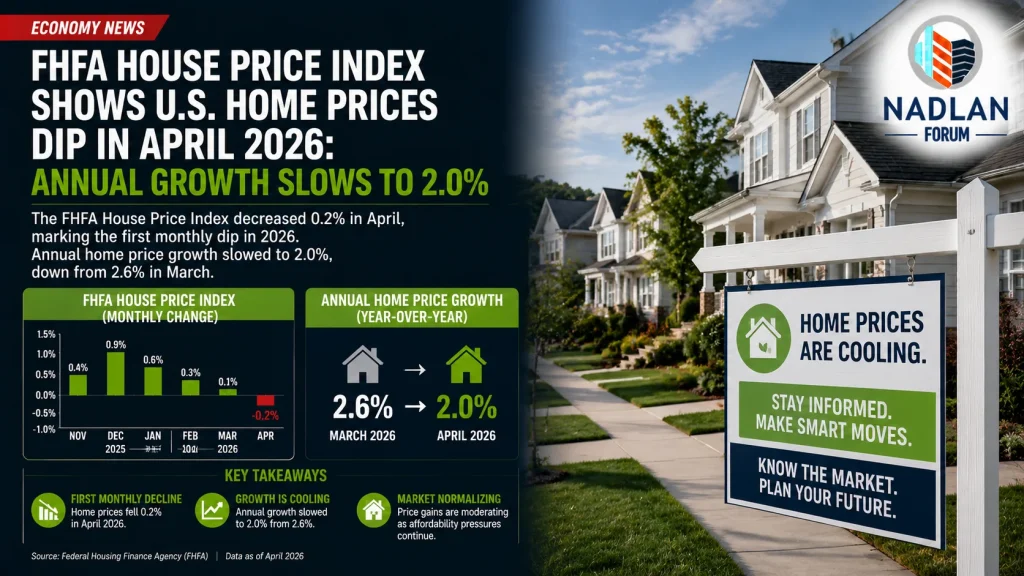
U.S. home prices recorded a slight decline in April 2026, according to the latest Federal Housing Finance Agency (FHFA) House Price Index, signaling continued moderation in the housing market after several years of strong price growth.
The report shows that home prices fell 0.1% on a seasonally adjusted monthly basis, reversing a small gain recorded in March. Despite the monthly decline, prices remained higher on a year-over-year basis, reflecting ongoing long-term appreciation across much of the country.
Annual home price growth slowed to 2.0%, down from stronger gains seen in previous years, suggesting that the housing market is gradually cooling but not collapsing.
Monthly Price Decline Signals Cooling Housing Market
The FHFA data indicates that U.S. housing prices are no longer rising at the rapid pace seen during the pandemic-era boom.
The 0.1% monthly decline in April marks a shift toward slower price growth, influenced by:
- Higher mortgage rates
- Reduced buyer affordability
- Slower housing demand
- Regional economic differences
- Increased inventory in select markets
While the decline is modest, it reflects a broader trend of stabilization in home prices after years of rapid appreciation.
Annual Growth Still Positive at 2.0%
Despite the monthly dip, home prices continue to rise on a year-over-year basis.
The FHFA index shows a 2.0% annual increase, confirming that the U.S. housing market is still experiencing positive long-term growth, even as momentum slows.
This slower pace of appreciation reflects a market adjusting to higher borrowing costs and shifting demand conditions.
Earlier data revisions also adjusted March figures slightly upward, indicating that price movements remain relatively stable rather than sharply volatile.
Regional Housing Market Performance Varies
The FHFA report highlights significant differences in housing performance across U.S. regions.
Strongest Performing Region
- New England: +1.0% monthly gain
Weakest Performing Region
- Mountain Division: -0.8% monthly decline
Over the past year, performance also varied widely:
- East North Central: +4.4% (strongest annual growth)
- Pacific Division: +0.2% (weakest annual growth)
These differences show that housing conditions remain highly localized, with some regions continuing to see steady demand while others experience cooling prices.
Mortgage Rates Continue to Influence Housing Demand
Housing analysts point to mortgage rates as one of the key drivers behind recent price moderation.
Freddie Mac data shows the average 30-year fixed mortgage rate near 6.49%, significantly higher than levels seen during the pandemic-era housing boom.
Higher borrowing costs reduce affordability, limiting the number of qualified buyers and slowing home price growth in many markets.
Some analysts also note that global economic tensions and energy price fluctuations have contributed to inflation concerns, indirectly influencing mortgage rates and housing demand.
Housing Supply Remains Tight Despite Cooling Prices
Even as price growth slows, the U.S. continues to face a structural housing shortage.
Industry estimates from the National Association of Home Builders suggest the country is still short by approximately 1.2 million housing units.
This shortage helps prevent more significant price declines, even when demand weakens due to higher interest rates.
As a result, the housing market is currently shaped by two opposing forces:
- Reduced demand from affordability pressures
- Ongoing supply constraints supporting prices
This balance has led to slower but still positive home price growth.
Long-Term Housing Trends Remain Intact
Despite short-term fluctuations, U.S. home prices have remained on a long-term upward trajectory.
The FHFA index shows that prices have generally increased consistently for more than a decade, supported by:
- Population growth
- Limited housing supply
- Low long-term construction rates
- Strong demand in suburban and Sun Belt markets
Even during periods of slowing growth, housing values have typically stabilized rather than declining sharply at the national level.
What to Expect in the Coming Months
The FHFA is scheduled to release its next monthly report covering May 2026 data on July 28.
Future housing price movements will likely depend on several key factors:
- Mortgage rate trends
- Inflation data
- Employment and wage growth
- Housing supply levels
- Regional economic performance
- Consumer confidence
If mortgage rates remain elevated, housing price growth may continue to slow or flatten. However, ongoing supply shortages could prevent widespread price declines.
Final Thoughts
The April 2026 FHFA House Price Index shows a modest 0.1% monthly decline in U.S. home prices, alongside a 2.0% annual increase, signaling a housing market that is cooling but still stable.
While higher mortgage rates and affordability challenges are reducing demand, long-term supply shortages continue to support home values in most regions.
Overall, the data suggests a transition toward a more balanced housing market, where rapid price growth has eased but widespread price drops have not yet materialized. For direct financing consultations or mortgage options for you visit 👉 Nadlan Capital Group.

























Responses