
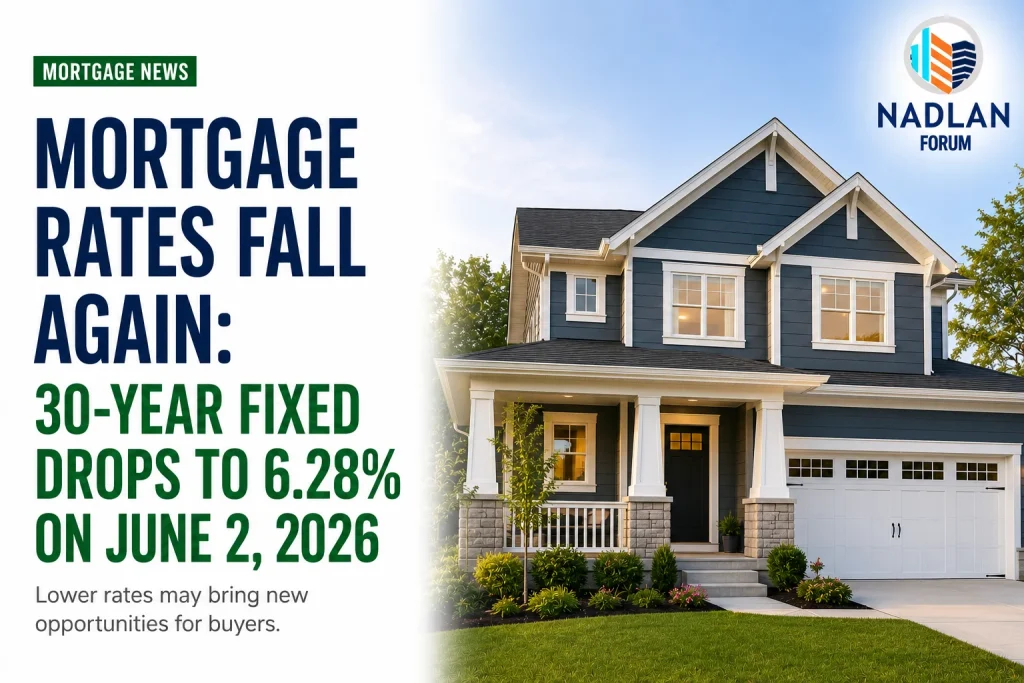
Mortgage Rates Fall Again: 30-Year Fixed Drops to 6.28% on June 2, 2026

Mortgage rates moved lower on Tuesday, offering some relief for homebuyers and homeowners considering refinancing. After several weeks of volatility driven by inflation concerns, bond market fluctuations, and global economic uncertainty, borrowing costs continued their gradual decline at the start of June.
According to the latest mortgage market data, the average 30-year fixed mortgage rate fell to 6.28%, while several other popular loan products also posted modest declines.
Although rates remain well above the historic lows seen during the pandemic, recent improvements are helping improve affordability for some buyers who have been waiting on the sidelines.
Current Mortgage Rates
As of June 2, 2026, average national mortgage rates were:
- 30-year fixed: 6.28%
- 20-year fixed: 6.12%
- 15-year fixed: 5.70%
- 5/1 ARM: 6.35%
- 7/1 ARM: 6.15%
- 30-year VA: 5.84%
- 15-year VA: 5.47%
- 5/1 VA: 5.49%
The 30-year fixed mortgage declined by five basis points from the previous day, while the 15-year fixed rate fell seven basis points. Adjustable-rate mortgage products also moved lower.
Refinance Rates Also Decline
Refinancing rates followed a similar pattern, creating additional opportunities for homeowners who secured higher mortgage rates during the past few years.
Current average refinance rates include:
- 30-year fixed refinance: 6.30%
- 20-year fixed refinance: 6.05%
- 15-year fixed refinance: 5.73%
- 5/1 ARM refinance: 6.21%
- 7/1 ARM refinance: 5.85%
- 30-year VA refinance: 5.73%
- 15-year VA refinance: 5.37%
- 5/1 VA refinance: 5.32%
For borrowers who obtained mortgages when rates were near their recent highs, even a modest decline could create opportunities to reduce monthly payments or shorten loan terms.
Why Mortgage Rates Are Moving Lower
Mortgage rates generally follow movements in the bond market, particularly the 10-year Treasury yield.
Over the past several weeks, investors have become somewhat more optimistic about inflation trends and broader economic conditions. While inflation remains above the Federal Reserve’s long-term target, recent data has shown signs that some price pressures may be easing.
As bond yields stabilize, mortgage lenders have gained room to reduce borrowing costs.
Market participants are also closely watching future Federal Reserve decisions, economic growth data, labor market conditions, and geopolitical developments that could influence interest rate expectations.
Affordability Gets a Small Boost
Lower mortgage rates improve affordability because they reduce monthly borrowing costs.
For example, on a $400,000 mortgage, even a quarter-point reduction in interest rates can save borrowers thousands of dollars over the life of the loan and lower monthly payments by a meaningful amount.
While home prices remain elevated in many parts of the country, declining mortgage rates can help offset some of those affordability challenges.
Many housing analysts believe affordability will continue improving if rates remain near current levels or move lower during the second half of 2026.
Fixed-Rate vs. Adjustable-Rate Mortgages
Homebuyers continue to choose between fixed-rate and adjustable-rate mortgage products based on their financial goals and time horizon.
A fixed-rate mortgage offers predictable monthly payments because the interest rate remains unchanged throughout the loan term.
An adjustable-rate mortgage (ARM) typically offers an introductory rate for a set number of years before adjusting periodically based on market conditions.
While ARMs sometimes begin with lower rates, borrowers face uncertainty once the adjustment period begins. Recent market conditions have reduced some of the traditional rate advantage that adjustable loans once offered, making fixed-rate mortgages attractive for many buyers.
30-Year vs. 15-Year Mortgage Options
The two most popular mortgage terms remain the 30-year and 15-year fixed-rate loan.
A 30-year mortgage generally provides lower monthly payments because repayment is spread over a longer period. This helps buyers maximize affordability and maintain flexibility within their monthly budget.
A 15-year mortgage offers a lower interest rate and significantly reduces total interest costs over the life of the loan. However, the shorter repayment schedule results in higher monthly payments.
Choosing between the two often depends on a borrower’s income, financial goals, and long-term plans.
Refinancing May Be Worth Revisiting
Recent rate improvements are prompting many homeowners to revisit refinancing opportunities.
Homeowners who purchased during periods when mortgage rates exceeded 7% may now find opportunities to reduce monthly payments or improve loan terms.
However, refinancing costs remain an important consideration. Closing costs, lender fees, and the expected length of homeownership should all be evaluated before making a decision.
Many financial experts recommend calculating a break-even point to determine how long it will take for monthly savings to offset refinancing expenses.
Outlook for Mortgage Rates
Industry forecasts remain relatively stable for the remainder of 2026.
Many economists expect the average 30-year fixed mortgage rate to remain in the low-to-mid 6% range through the end of the year. While significant declines appear unlikely in the near term, gradual improvements remain possible if inflation continues cooling and economic conditions stabilize.
Housing market activity is expected to remain sensitive to rate movements, with buyers responding quickly whenever affordability improves.
For now, the latest decline in mortgage rates provides a welcome development for both prospective homebuyers and current homeowners looking for financing opportunities.
As summer progresses, rate trends, inflation reports, employment data, and Federal Reserve policy decisions will continue shaping the direction of the mortgage market. For direct financing consultations or mortgage options for you visit 👉 Nadlan Capital Group.


























Responses