
California Sues Five Cities Over Housing Plan Violations and Delayed Compliance

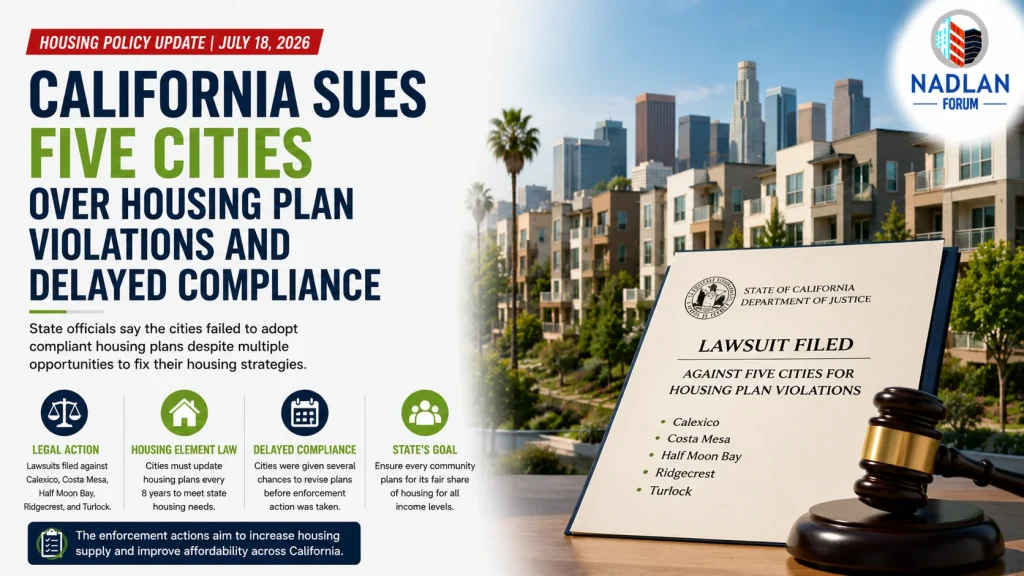
California has taken legal action against five cities that state officials say repeatedly failed to adopt housing plans that comply with state law.
The lawsuits target Calexico, Costa Mesa, Half Moon Bay, Ridgecrest, and Turlock. California Attorney General Rob Bonta and the California Department of Housing and Community Development announced the enforcement actions on July 16, 2026.
State officials argue that the cities were given several opportunities to revise their housing plans, address identified problems, and complete required zoning changes before the cases were referred for legal enforcement.
The lawsuits represent the latest step in California’s effort to require every local government to plan for its share of the state’s housing needs.
What California’s Housing Element Law Requires
Every California city and county must periodically update the housing element of its general plan.
A housing element explains how a community intends to accommodate future housing development for people at different income levels. It generally identifies suitable sites, zoning capacity, local housing programs, development barriers, and strategies for meeting regional housing targets.
These plans must be updated on an eight-year schedule and must address each jurisdiction’s assigned share of regional housing needs.
The requirement does not necessarily mean that a city must directly construct every assigned home. However, it must create a legally adequate plan and zoning framework that allows the required housing to be developed.
California officials allege that the five cities have not completed those obligations despite repeated warnings and technical assistance.
State Says Cities Received Multiple Opportunities
Before beginning enforcement, the state says housing officials issued notices of violation, provided written findings, offered meetings, and allowed the affected jurisdictions time to respond.
According to the Attorney General’s Office, the cities were given multiple opportunities to correct their plans before legal action was taken.
Housing officials commonly review draft plans and return comments identifying areas that must be changed before certification can be granted.
Those changes may involve:
- Identifying enough realistic development sites
- Updating zoning rules
- Addressing barriers to affordable housing
- Demonstrating adequate capacity for assigned housing units
- Establishing clear deadlines for housing programs
- Completing required rezoning
The state argues that timely compliance is especially important because California is already more than halfway through the current housing-planning cycle.
More Than 95% of Communities Have Complied
California officials said more than 95% of local jurisdictions have achieved compliance during the current planning cycle.
The state is using that figure to argue that the requirements are achievable and that continued noncompliance by a small number of cities should not be accepted.
Housing and Community Development Director Gustavo Velasquez said most cities and counties have completed their responsibilities, while jurisdictions that remain behind should understand that no community is exempt from state housing law.
The department’s enforcement division can investigate potential violations, revoke housing-element certification and refer cases to the Attorney General’s Office when local governments fail to correct identified problems.
Governor Newsom Calls for Local Accountability
Governor Gavin Newsom said California cannot address its housing shortage while some cities continue delaying required planning.
According to the governor’s office, the five cities had repeated opportunities to comply with the law but failed to complete the necessary work.
The administration has increasingly used legal action, court-enforced agreements and financial penalties to pressure local governments into adopting compliant plans.
State leaders maintain that local resistance or delay can prevent new housing from moving forward, particularly in communities where zoning restrictions already limit available development opportunities.
Huntington Beach Case Strengthened State Enforcement
The new lawsuits follow a long-running dispute between California and Huntington Beach over state housing requirements.
In May 2026, a Superior Court judge ordered Huntington Beach to pay approximately $160,000 in penalties, with additional fines of $50,000 per month beginning in June while the city remained out of compliance.
The California Supreme Court had previously declined to hear Huntington Beach’s attempt to challenge a ruling requiring the charter city to follow state housing law.
That case reinforced California’s position that charter-city status does not automatically allow a community to avoid statewide housing-planning requirements.
State officials are now using the outcome as a warning that delayed compliance can lead to financial penalties, court orders and reduced local control.
Calexico Says It Is Revising Its Plan
Calexico responded by saying it has made significant progress on its housing element and is continuing to incorporate state feedback into a revised draft.
City representatives said local officials are refining housing programs, policy language and the analysis of sites that could support future development.
Calexico expects to submit another version of the plan for state review.
The city’s response suggests that it believes certification may still be achieved through continued cooperation, even as the legal case moves forward.
Costa Mesa Questions the Need for a Lawsuit
Costa Mesa officials expressed disappointment with the state’s decision to file a lawsuit.
Mayor John Stephens said the city has been working with housing officials and was waiting for comments on its latest submission when the legal action was announced.
The city argues that it has already made progress on housing production and has been actively pursuing certification.
California’s complaint, however, alleges that Costa Mesa still has not adopted a legally compliant housing element. Local officials question why litigation is necessary while discussions with the state remain ongoing.
Ridgecrest Expects Certification Soon
Ridgecrest said it had not yet been formally served with the lawsuit when it learned about the state’s announcement.
The city maintains that it continues to work with the Department of Housing and Community Development and that the agency is reviewing its most recent draft.
Ridgecrest officials said they expect to receive certification in the near future.
The disagreement may therefore focus partly on whether the city’s progress is sufficient and whether enforcement should continue while the latest revisions are being reviewed.
Turlock Says Recent Revisions Address State Concerns
Turlock also said it remains focused on achieving compliance.
City officials reported making substantial progress through the state review process and said the latest version of the housing element addresses statutory issues identified in earlier reviews.
The state is nevertheless seeking a court order requiring Turlock to bring its housing element into compliance and complete necessary rezoning. According to reporting on the filing, California is also seeking temporary remedies that could affect the city’s authority over certain development permits while requiring some residential projects to proceed.
Half Moon Bay Says Its Plan Meets Most Requirements
Half Moon Bay said it has been working on its sixth-cycle housing element since 2022.
According to the city, state housing officials determined in February 2026 that its housing element met statutory requirements, with remaining work focused on zoning updates needed for full compliance.
This distinction is important because a city may have a housing plan that satisfies much of the required analysis while still remaining legally noncompliant until associated rezoning is completed.
The state appears to be taking the position that partial progress does not replace full and timely compliance.
Why Housing Elements Matter
Housing elements influence where and how future residential construction can occur.
When a city fails to identify adequate sites or complete required zoning, it can limit the ability of developers to construct:
- Single-family homes
- Apartments
- Affordable housing
- Senior housing
- Supportive housing
- Mixed-income communities
In areas with high land costs and limited supply, delays in planning can intensify competition for existing homes and contribute to rising rents and prices.
State officials argue that every community must create room for new housing rather than shifting the responsibility to neighboring cities.
Possible Consequences for Noncompliant Cities
Cities that remain out of compliance can face several legal and financial consequences.
Potential penalties may include:
- Court orders requiring plan revisions
- Mandatory zoning changes
- Financial fines
- Loss of access to certain state funding programs
- Reduced control over some housing applications
- Suspension of authority over certain development decisions
- Exposure to builder’s remedy projects
Under the builder’s remedy, developers may be able to pursue qualifying housing projects that do not follow all local zoning restrictions when a city lacks a compliant housing element, subject to applicable legal standards.
These consequences give local governments a strong incentive to complete their plans before disputes reach court.
Cities and State Remain Divided Over Timing
The five cities generally argue that they are actively working toward compliance and that their most recent submissions reflect substantial progress.
California officials respond that the cities have already had considerable time, assistance and multiple opportunities to satisfy the law.
This creates a central dispute over whether ongoing negotiations should be enough to delay enforcement.
For the state, progress without final compliance is no longer sufficient. For the cities, filing lawsuits while revised plans are under review may appear unnecessary or premature.
What Happens Next
The legal proceedings could result in settlements, court-approved compliance agreements or judicial orders requiring the cities to complete specific actions within firm deadlines.
Some cities may reach certification while litigation is still underway, potentially narrowing the disputes or leading to negotiated resolutions.
However, the Newsom administration has made clear that it intends to achieve broader statewide compliance and will continue pursuing local governments that remain behind.
The cases may also serve as a warning to other jurisdictions that incomplete zoning, delayed revisions or continued negotiations will not necessarily prevent legal action.
California Housing Outlook
California continues to face a serious shortage of homes, particularly in coastal regions and employment centers where housing production has not kept pace with population and job growth.
The state has responded by adopting stronger housing laws, increasing enforcement and limiting the ability of local governments to block certain projects.
The lawsuits against Calexico, Costa Mesa, Half Moon Bay, Ridgecrest, and Turlock show that housing-element enforcement is becoming a central part of that strategy.
The final outcomes will determine not only how quickly the five cities must revise their plans, but also how aggressively California can intervene when local housing policies fall behind state requirements. For direct financing consultations or mortgage options for you visit 👉 Nadlan Capital Group.

























Responses