
Existing-Home Market Shows Early Signs of Revival Amid Improved Affordability


After a lengthy slowdown that has weighed heavily on the housing sector, new data from First American suggests that the existing-home market is finally beginning to show signs of life. Modest improvements in affordability, along with a slight dip in mortgage rates and an uptick in buyer activity, indicate that demand may be stirring once again.
The Existing-Home Sales Outlook model points to a mild but encouraging rebound in September, projecting that sales will rise both from the prior month and compared to last year. While the recovery remains gradual, analysts say these developments signal a potential turning point after years of stagnation.
Slow but Steady Improvement
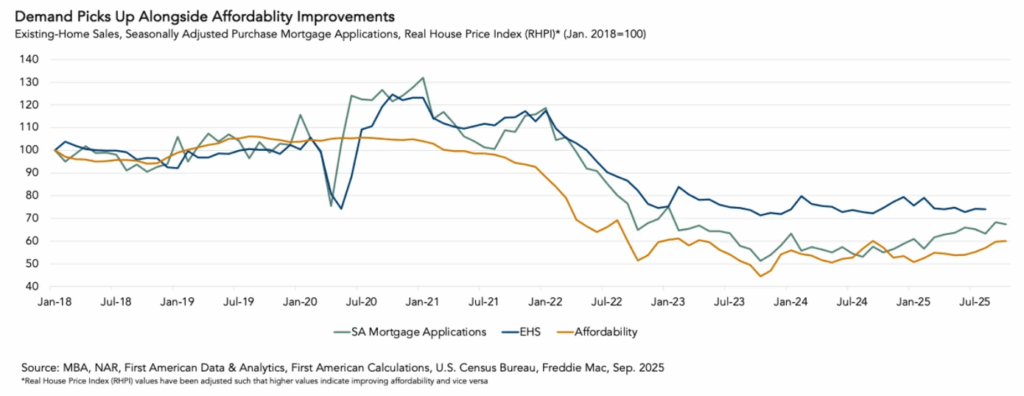
Before the pandemic, existing-home sales represented roughly 4.1% of all U.S. households, translating to an annualized pace of around 5.4 million transactions. Today’s sales rate near 4 million remains far below that benchmark, highlighting how sluggish market activity has become. However, experts note that the issue isn’t a lack of willing movers but rather a constrained market shaped by affordability challenges and limited inventory.
Data from mortgage applications supports this cautious optimism. Weekly purchase applications rose nearly 8% in September from the previous month and were up 19% year-over-year, suggesting renewed interest among buyers. As affordability improves, more prospective homeowners appear to be testing the market.
Key Takeaways from First American’s Findings
- Existing-home sales are expected to climb 3.2% compared with last year and 0.6% month-over-month in September.
- The increase is driven by a combination of factors: a stronger economy (+0.3%), greater purchasing power (+0.3%), a moderate easing of the “rate lock-in” effect (+0.2%), and better credit availability (+0.04%).
- Mortgage rates have edged lower, improving affordability and helping lift buyer sentiment.
- Application data suggests that while demand is rising, activity remains far below historical norms.
- Reluctant sellers many of whom hold ultra-low pandemic-era mortgage rates continue to limit inventory and slow the pace of recovery.
Affordability Gains Offer Hope, But Barriers Persist
September marked the highest level of home-buying power since early 2022, driven by moderate rate declines, wage growth, and stable prices. According to the Real House Price Index, which adjusts for income and rate changes, affordability improved to its best level in a year. This has encouraged some buyers and sellers who had been waiting on the sidelines to cautiously reenter the market.
Yet, these gains have not erased the affordability gap that widened during the housing boom. By comparison, affordability remains about 65% below the pre-pandemic five-year average. Many homeowners remain psychologically anchored to their low pandemic mortgage rates and are hesitant to sell unless they can secure equally favorable financing or higher home values. As a result, withdrawal rates among sellers remain elevated, keeping inventory levels tight and limiting transaction volume.
“Life Events” Continue to Drive Market Activity
“Housing turnover still happens because life still happens,” said Odeta Kushi, Deputy Chief Economist at First American. “Events like marriage, growing families, career changes, and divorce have always influenced housing demand, and that won’t change regardless of where interest rates or prices go.”
Even in a sluggish economy, these personal milestones ensure a baseline level of movement in the housing market. However, broader forces such as low consumer confidence, stubborn inflation, and slowing job growth continue to create a cautious environment for both buyers and sellers.
Outlook: Recovery in Motion, But Gradual
While the market is far from returning to pre-pandemic norms, the latest data points to gradual stabilization. As affordability slowly improves, the “rate lock-in” effect diminishes, and economic uncertainty eases, experts believe the housing market is inching toward balance.
“The recovery will take time,” Kushi noted, “but each incremental improvement in affordability or sentiment brings us one step closer to a more active and healthy housing market.”For direct financing consultations or mortgage options for you visit 👉 Nadlan Capital Group.
















Responses