
Report Warns Tens of Thousands of NYC Affordable Homes Could Lose Protections by 2037

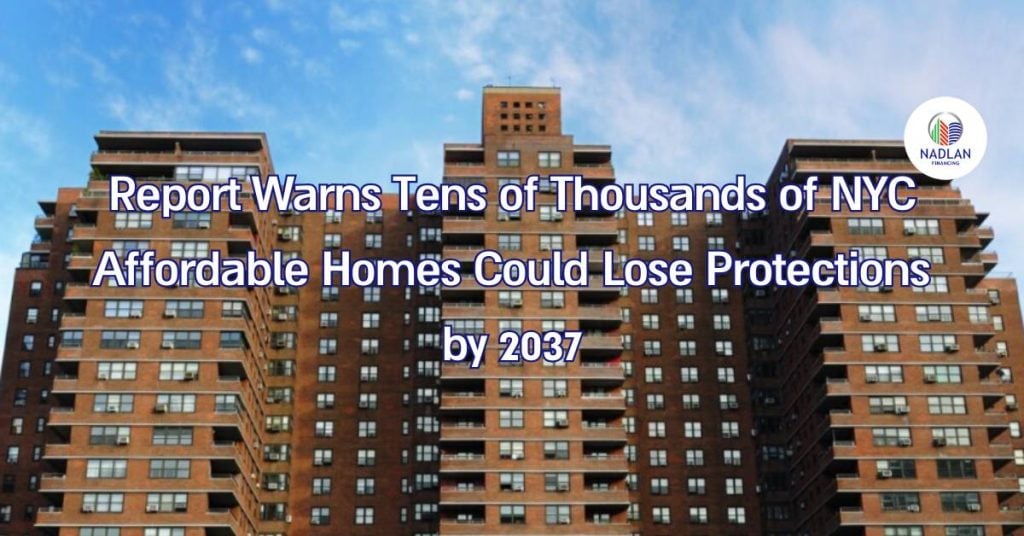
New York City may be heading toward a housing affordability cliff, according to a new report by the Association for Neighborhood & Housing Development (ANHD). The study, titled “Preserving the Foundation: The Crisis Facing New York City’s Affordable Housing,” finds that tens of thousands of once-subsidized apartments are at risk of losing their affordability protections in the next decade as long-term agreements and mortgages mature.
For decades, New York City has relied on public subsidies and regulatory agreements to create and maintain affordable housing. But as those agreements expire, the city faces the prospect of losing a large share of the affordable stock that low- and moderate-income residents depend on a trend that could reshape the city’s housing landscape.
The Scale of the Problem
Between 1987 and 2007, the city helped finance the creation of nearly 300,000 affordable housing units through various subsidy programs. Of those, 234,508 rental units were protected by time-limited affordability covenants agreements that restrict how much landlords can charge.
ANHD’s analysis shows that 169,561 of these units (about 72%) are at risk of losing their affordability by 2037 as their mortgages mature and their agreements expire. The group warns that this estimate is conservative, since it excludes some homeownership and state-funded developments that could also lose protections in the years ahead.
“This is not a future problem it’s a current one that’s accelerating,” said Barika Williams, Executive Director of ANHD. “Each year, thousands of affordable homes slip out of regulation, and unless the city acts now, we will lose a core part of New York’s housing safety net.”
A Slow-Moving but Growing Crisis
The timeline of expirations shows that affordability losses began around 2017, roughly thirty years after the earliest subsidized buildings were completed. The pace has since quickened: the largest single-year wave of expiring units occurred in 2020, when nearly 19,000 apartments faced the end of their affordability terms.
Unless new agreements are negotiated or policies change, ANHD projects a steady drumbeat of losses continuing each year through the 2030s. The report characterizes the situation as a “slow-motion crisis” that could quietly erode New York’s affordable housing base over time.
These losses are particularly concerning, ANHD notes, because they come at a time when the city’s housing costs remain historically high, vacancy rates are near record lows, and new construction struggles to keep pace with population and job growth.
The Case for Permanent Affordability
Perhaps the report’s most sobering revelation is that fewer than 1% of the nearly 300,000 subsidized units created during that 20-year span were required to remain permanently affordable. The overwhelming majority were only guaranteed for a fixed term usually 30 to 40 years.
“We’re essentially rebuilding the same problem every generation,” the report argues. “Each cycle of temporary affordability creates another cliff we must eventually address.”
The authors call for a shift in policy toward “permanent affordability” as a guiding principle in all future housing deals. This approach would ensure that once a unit is built as affordable, it stays that way indefinitely avoiding the recurring crisis of expiring covenants that has become a hallmark of New York’s housing system.
Some nonprofit developers and community land trusts have already begun pursuing this model, embedding affordability into ownership structures that prevent resale at market rates. But scaling those solutions citywide will require new financial tools, stronger oversight, and greater political will.
Financial and Structural Hurdles
ANHD acknowledges that extending or renewing affordability terms is rarely simple. Most of the city’s affordable housing was built with complex layers of public subsidies and private financing, and many owners depend on rent increases to cover maintenance and rising costs. Without new funding or tax incentives, property owners may be unwilling or unable to keep rents below market once their agreements expire.
“Affordable housing has almost never been built or preserved without government intervention,” the report emphasizes. “To maintain affordability, ongoing public commitment is essential.”
Experts say that creating a permanent solution will require coordinated action between city, state, and federal agencies particularly since federal programs such as Low-Income Housing Tax Credits (LIHTC) have their own expiration timelines that often coincide with local ones.
A Warning Beyond New York
While the report focuses on New York City, the issue is national in scope. Across the country, thousands of older subsidized housing developments built in the 1970s through 1990s are approaching the end of their affordability terms. Cities like Los Angeles, Chicago, and Boston face similar challenges as owners decide whether to renew affordability agreements or convert units to market-rate housing.
ANHD’s researchers warn that if cities fail to intervene, the result could be a steep drop in the national supply of affordable rentals, erasing decades of public investment and intensifying the housing affordability crisis.
The Road Ahead
In response to the report, housing advocates are urging New York City to take immediate steps to strengthen its preservation strategy such as establishing new funding streams for affordability extensions, creating incentives for property owners to renew covenants, and prioritizing permanent affordability in all new projects.
“We can’t build our way out of this problem alone,” said Williams. “Preservation is just as critical as production. If we don’t act now, we risk losing the very foundation of affordability that has kept this city livable for generations.”
As the city continues to grapple with rising rents, limited supply, and widening inequality, ANHD’s findings serve as a stark reminder: without decisive policy changes, the next chapter in New York’s housing story could be one of deepening scarcity and displacement. For direct financing consultations or mortgage options for you visit 👉 Nadlan Capital Group.



















Responses