
Historical Mortgage Rates Explained: How Home Loan Rates Changed Over Time

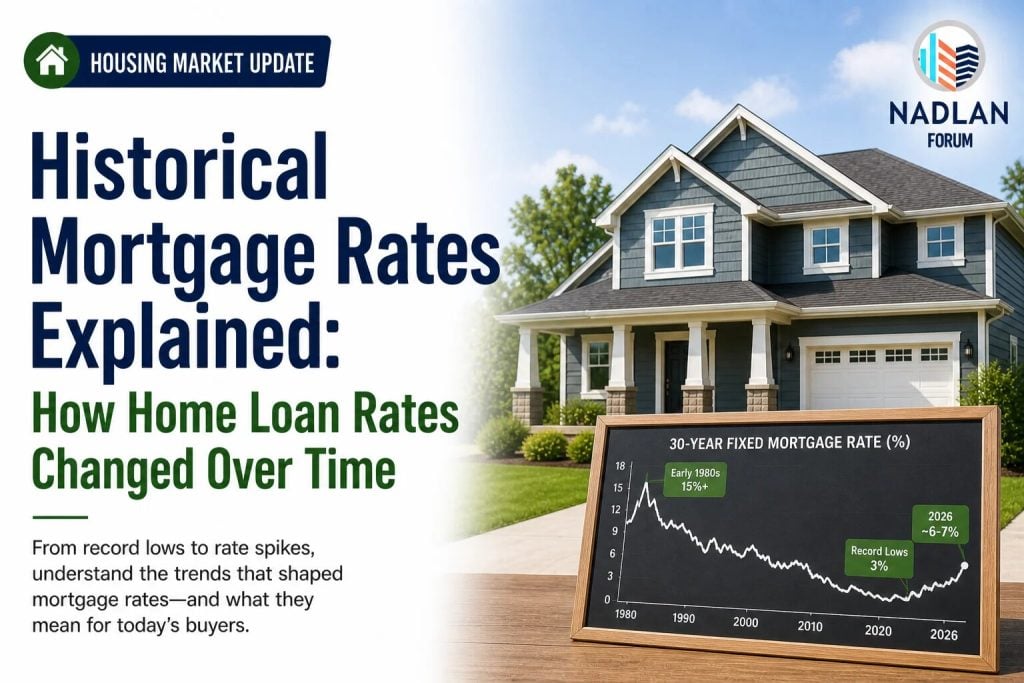
Mortgage rates today may feel high compared to recent years, but a look at history tells a different story. Over the past five decades, home loan rates have moved through extreme highs and record lows, shaped by inflation, economic cycles, and global events.
Understanding historical mortgage rates can help buyers put today’s numbers into perspective and make more confident decisions.
A Quick Look at Mortgage Rate History
Mortgage rate tracking in the U.S. began after Freddie Mac was created in 1970 to support the housing market.
Since then, rates have seen dramatic changes:
- Peak: 16.64% in 1981
- Lowest: Around 2.96% in 2021
- Current (2026): Around 6% to mid-6% range
While today’s rates are higher than the pandemic lows, they are still far below historic peaks.
Mortgage Rates in the 1970s
The 1970s marked the beginning of rising borrowing costs.
- Lowest average: 7.38%
- Highest average: 11.20%
Rates climbed steadily due to high inflation during a period often called the “Great Inflation.” Economic policies and rising prices pushed borrowing costs higher throughout the decade.
Mortgage Rates in the 1980s
The 1980s saw the highest mortgage rates in modern history.
- Lowest average: 10.19%
- Highest average: 16.64%
In 1981, rates hit their peak. Inflation, oil shocks, and policy changes drove borrowing costs to extreme levels. Over time, rates gradually declined but remained above 10% for much of the decade.
Mortgage Rates in the 1990s
Rates began to stabilize in the 1990s.
- Lowest average: 6.94%
- Highest average: 10.13%
Improved economic conditions and shifts in investment patterns helped bring rates down. By the late 1990s, borrowers were seeing rates below 7%, which felt like a major improvement at the time.
Mortgage Rates in the 2000s
The early 2000s started with higher rates but ended with a sharp drop.
- Lowest average: 5.04%
- Highest average: 8.05%
The housing market boom and later the financial crisis played a big role. After the crash, the Federal Reserve lowered rates to support the economy, bringing mortgage rates down significantly.
Mortgage Rates in the 2010s
The 2010s were defined by relatively low and stable rates.
- Lowest average: 3.65%
- Highest average: 4.69%
Rates stayed below 5% for most of the decade. Even when they rose slightly, they remained far below historical highs.
Mortgage Rates in the 2020s
The 2020s brought both record lows and a sharp rebound.
- Lowest average: 2.96% (pandemic period)
- Highest recent average: around 6.8%
During the COVID-19 period, rates dropped to historic lows to support borrowing. But as inflation increased, rates moved back up, settling in the 6% range by 2026.
What Drives Mortgage Rate Changes
Mortgage rates do not move randomly. Several key factors influence them:
1. Inflation
When inflation rises, lenders increase rates to maintain returns.
2. Treasury Yields
Mortgage rates closely follow the 10-year Treasury yield, which reflects long-term economic expectations.
3. Federal Reserve Policy
While the Federal Reserve does not set mortgage rates directly, its decisions influence borrowing costs across the economy.
4. Economic Growth
Strong economies often lead to higher rates, while weaker conditions push rates down.
5. Global Events
Events like wars, trade policies, or market shocks can quickly impact rates.
How Your Personal Profile Affects Your Rate
Even though market conditions matter, your personal finances also play a big role.
Lenders consider:
- Credit score
- Down payment size
- Debt-to-income ratio
- Loan type
For example, government-backed loans may offer lower rates compared to conventional options.
Mortgage Rates and the Housing Market
Mortgage rates directly affect housing demand.
- Lower rates → More buyers → Higher home prices
- Higher rates → Fewer buyers → Slower price growth
When rates drop, buyers gain more purchasing power. When rates rise, affordability becomes more challenging.
Should You Wait for Lower Rates?
Many buyers try to time the market, but this can be risky. Rates may go down in the future, but home prices and competition may increase at the same time.
Instead of waiting, buyers should focus on:
- What they can afford today
- Long-term financial stability
- Opportunities to refinance later
Refinancing and Rate Changes
Refinancing becomes attractive when rates fall. A common guideline is to refinance if you can reduce your rate by at least 1%.
However, timing matters. If you plan to move soon, the cost of refinancing may not be worth it.
Key Takeaways
- Historical mortgage rates have ranged from under 3% to over 16%
- Today’s rates are moderate compared to long-term history
- Inflation, the economy, and global events drive rate changes
- Personal finances also affect the rate you receive
- Waiting for lower rates is not always the best strategy
Final Thoughts
Looking at historical mortgage rates helps put today’s market into context. While rates are higher than recent lows, they are still far from the levels seen in earlier decades.
For buyers, the goal should not be to predict the perfect moment, but to make a decision based on current financial readiness. With the option to refinance later, entering the market at the right time for your situation can still be a smart move. For direct financing consultations or mortgage options for you visit 👉 Nadlan Capital Group.

























Responses