
HUD Suspends Virgin Islands Housing Funding: Federal Review Finds Major Management Failures

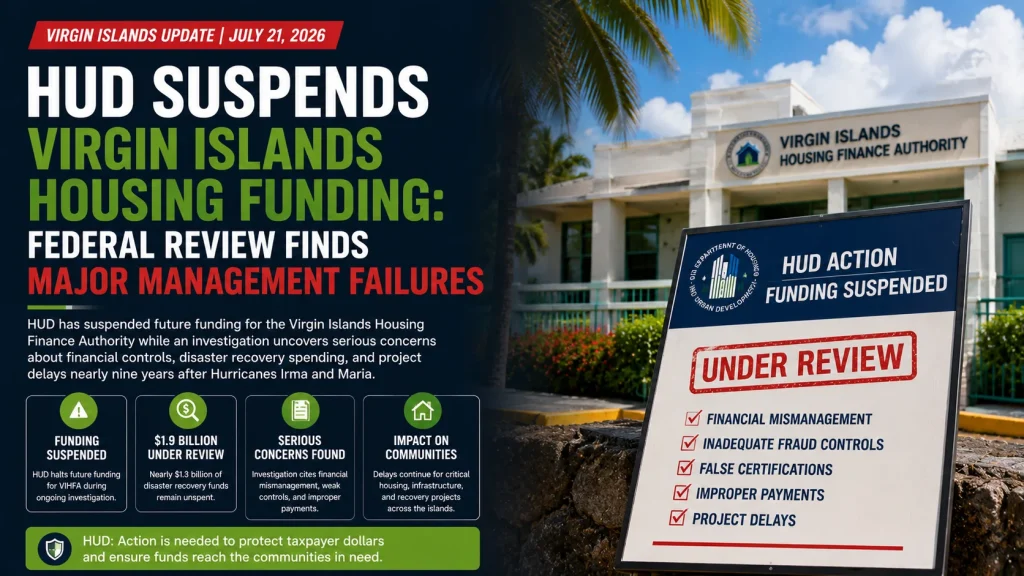
The U.S. Department of Housing and Urban Development has suspended the Virgin Islands Housing Finance Authority from receiving additional federal funding after an investigation raised serious concerns about financial controls, disaster recovery spending, and the slow completion of housing projects.
HUD said the action took effect immediately and will remain in place while federal investigators continue reviewing the authority’s management of nearly $1.9 billion in disaster recovery assistance awarded after Hurricanes Irma and Maria struck the U.S. Virgin Islands in 2017.
Nearly nine years after the storms, only about $570 million of that funding had been spent, leaving roughly $1.3 billion that had not yet reached the housing, infrastructure, and community recovery programs for which Congress intended it.
The suspension does not represent a final finding against every current or former official. However, HUD said its investigation uncovered evidence of widespread financial mismanagement, inadequate fraud controls, false certifications, improper payments, and possible misuse of federal funds.
HUD Stops Additional Funding During Investigation
Housing Secretary Scott Turner announced that the Virgin Islands Housing Finance Authority, commonly known as VIHFA, would be suspended from future federal procurement and non-procurement transactions while the investigation continues.
The decision means the authority cannot receive additional covered federal awards during the suspension period unless an exception is approved.
HUD said the step was necessary to protect taxpayer money and prevent further risk while investigators examine the agency’s financial practices, compliance systems, and past spending decisions.
The department described the authority’s record as a serious failure of disaster recovery administration, arguing that residents were still waiting for housing and infrastructure improvements nearly a decade after the hurricanes.
The authority has the right to challenge the suspension and request an administrative hearing.
Nearly Two-Thirds of Recovery Funding Remains Unspent
The U.S. Virgin Islands received almost $2 billion through HUD’s Community Development Block Grant Disaster Recovery and Mitigation programs.
These grants were intended to help the territory repair homes, restore infrastructure, improve the electrical system, and strengthen communities against future disasters.
According to federal officials, VIHFA had spent less than one-third of the total award by July 2026.
HUD said the slow pace had prevented Virgin Islands residents from receiving approximately $1.3 billion in assistance that had already been authorized for recovery.
Spending federal disaster money can take time because projects must meet environmental, procurement, engineering, and financial rules. However, HUD concluded that the delays in this case went beyond normal administrative challenges.
The department pointed to unfinished housing programs, weak oversight, questionable expenses, and a failure to establish reliable fraud-prevention systems.
Housing Projects Show Limited Progress
The federal review found that only a small number of planned housing projects had reached completion.
According to HUD’s findings, VIHFA completed just two of 95 planned single-family rental rehabilitation projects.
The authority had also completed none of the 329 planned single-family and multifamily housing projects included in the recovery program.
Federal officials also said only about 2% of the electrical grid recovery funding had been spent as of May 2026, despite the continued need for reliable power infrastructure across the territory.
These numbers became a central part of HUD’s argument that the recovery effort had moved far too slowly.
For residents still living with storm damage, high housing costs, unreliable utilities, or limited affordable options, the lack of completed projects has had direct consequences.
Fraud Controls Rated at the Lowest Level
Concerns about VIHFA’s oversight systems were documented before the latest suspension.
HUD’s Office of Inspector General audited the authority’s fraud risk management practices and found them at or below the lowest desired level of maturity.
The review examined whether VIHFA had adequate systems to prevent, identify, report, and respond to fraud while managing federal disaster recovery funds.
A strong fraud risk program normally includes clear reporting procedures, independent oversight, employee training, written controls, conflict-of-interest rules, and a process for investigating suspicious conduct.
Investigators concluded that VIHFA needed stronger leadership involvement and a more complete fraud risk management program.
The Inspector General recommended that senior officials and the authority’s board establish a stronger anti-fraud culture and create specific procedures for employees to report suspected misconduct.
Former Senior Official Convicted in Fraud Case
HUD also cited the criminal conviction of a former VIHFA chief operating officer who had overseen disaster recovery programs.
The former official was sentenced to federal prison after being convicted of fraud, money laundering, criminal conflict of interest, and related offenses.
Federal authorities said the case involved a lumber contract intended to support the rebuilding of hurricane-damaged homes.
The contract was allegedly increased from approximately $3 million to $4.5 million, while the former official received a kickback of about $107,000.
The lumber later became unusable after being left exposed, according to federal statements reported in connection with the suspension.
HUD used the case as evidence that stronger financial controls and conflict-of-interest protections were needed within the authority.
HUD Questions Duplicate Disaster Costs
The investigation also found that VIHFA sought approximately $6.2 million for disaster-related expenses that the Federal Emergency Management Agency had already paid.
Receiving payment from two federal programs for the same expense is generally prohibited.
Federal disaster programs require agencies to document costs carefully and ensure that expenses are not reimbursed more than once.
HUD said the attempted duplicate reimbursement raised further concerns about the authority’s financial review process and the accuracy of its payment requests.
The department is now examining whether the request resulted from poor recordkeeping, inadequate coordination, false information, or another compliance failure.
False Certifications Are Under Review
HUD also alleges that VIHFA repeatedly certified that it maintained an effective financial compliance system even though investigators found major weaknesses in its controls.
Federal grant recipients are often required to certify that they follow procurement rules, manage conflicts of interest, maintain accurate records, and have systems in place to prevent fraud and misuse.
HUD said evidence suggests that some of VIHFA’s certifications may have been false or misleading.
The department is also reviewing whether additional certifications were submitted to obtain further funding.
These claims remain part of an ongoing investigation, and the final legal or administrative findings may depend on the evidence collected by HUD and its Office of Inspector General.
Administrative Spending Draws Scrutiny
HUD said the authority had already spent more than half of the grant money set aside for administrative costs while completing only a small portion of the planned recovery work.
Administrative spending can include salaries, consulting, planning, compliance, legal services, project management, and financial reporting.
Those expenses are necessary in large recovery programs, but they are expected to support the delivery of actual housing and infrastructure projects.
Federal officials questioned why administrative funds were being used at a much faster rate than construction and rehabilitation funds.
This imbalance helped support HUD’s conclusion that the program was not delivering results at an acceptable pace.
Federal Letter Criticizes the Recovery Record
HUD Deputy Secretary Andrew Hughes outlined the department’s concerns in a 13-page letter addressed to the authority’s leadership.
The letter said Virgin Islands residents still had not received the housing and reliable electrical power promised after the 2017 hurricanes.
It accused VIHFA of failing to manage taxpayer funds properly, violating federal procurement standards, and making inaccurate statements about its financial controls and conflicts of interest.
The letter also stated that HUD’s Office of Inspector General was investigating possible offenses involving the authority, its officers, directors, or employees.
HUD characterized the pace of recovery as extremely slow and said the federal government would no longer accept repeated delays without stronger accountability.
Hurricanes Irma and Maria Caused Severe Damage
The funding was awarded after two Category 5 hurricanes struck the U.S. Virgin Islands within weeks of each other in September 2017.
Hurricane Irma damaged homes, businesses, roads, and utilities across St. Thomas and St. John.
Hurricane Maria later struck St. Croix and caused additional destruction throughout the territory.
The back-to-back disasters damaged large portions of the housing stock and placed enormous pressure on the local electrical, healthcare, and public service systems.
Recovery has been especially difficult because construction materials must often be shipped to the islands, labor costs are high, and large infrastructure projects require complex federal approvals.
However, federal officials said those challenges did not excuse the authority’s financial and management failures.
Virgin Islands Governor Questions HUD’s Approach
Virgin Islands Gov. Albert Bryan Jr. said the suspension came as a surprise and criticized the wording and public release of HUD’s letter.
The governor questioned whether the action may have been influenced by politics and raised concerns that a national news organization reportedly obtained the information before the territorial government received a full public explanation.
Bryan said his administration intended to investigate the circumstances surrounding the announcement and appeal the suspension.
He also argued that the letter’s tone appeared unusually harsh.
The governor did not deny that the recovery process had faced delays, but he suggested that the federal action did not fairly represent all of the work completed by the territorial government.
Concerns Crossed Political Administrations
Questions about VIHFA’s performance did not begin with the current administration.
Previous federal reviews and local legislative hearings had also raised concerns about slow spending, weak accountability, and money remaining unused while residents continued waiting for assistance.
HUD’s Inspector General began examining the authority’s fraud controls because of the unusually large amount of disaster recovery money awarded to the territory following the 2017 hurricanes.
In early 2026, Virgin Islands lawmakers separately questioned why millions of dollars in other housing assistance programs remained idle while funding deadlines approached.
Local senators were told that only about $4.3 million of $8.5 million in Homeowner Assistance Fund money had been spent, leaving approximately $4.2 million that needed to be used before a September 2026 deadline.
These earlier concerns suggest that the current dispute reflects a long-running problem rather than a single recent event.
Leadership Changes Add to the Uncertainty
The authority has experienced changes in senior leadership while facing criticism over stalled recovery projects.
Eugene Jones Jr., who became executive director in April 2024, resigned in 2026 as local lawmakers continued pressing the agency for answers about delayed programs and unused funds.
The authority has also faced a whistleblower lawsuit from a former chief operating officer who claimed she was dismissed after reporting alleged improper or illegal activities.
The defendants have the opportunity to respond to those claims through the legal process, and the lawsuit remains separate from HUD’s suspension decision.
However, the leadership turnover and ongoing litigation have added further uncertainty to an agency already responsible for managing one of the territory’s largest federal recovery programs.
What the Suspension Means for Residents
The immediate concern is whether the funding suspension could cause additional delays for families waiting for housing assistance.
HUD’s action is intended to prevent further financial risk, but it may also slow contracts, reimbursements, and new project approvals unless the federal government creates another way to administer the money.
Residents may be affected through delays involving:
- Home repair and reconstruction
- Rental rehabilitation
- Affordable housing development
- Infrastructure improvements
- Electrical grid projects
- Community resilience programs
- Assistance for low- and moderate-income households
HUD has not said that Congress is taking the remaining money away from Virgin Islands residents.
Instead, the dispute centers on whether VIHFA can continue controlling and distributing the funds under its current management and compliance systems.
Possible Next Steps
VIHFA can appeal the suspension and request a hearing to challenge HUD’s findings.
The authority may also submit a corrective action plan explaining how it intends to strengthen financial controls, address audit findings, improve fraud prevention, and speed up project completion.
HUD could eventually lift the suspension if it determines that the risks have been corrected.
Other possible outcomes include:
- Appointment of an independent financial monitor
- Replacement of senior program officials
- Transfer of some responsibilities to another agency
- Stronger federal approval requirements
- Recovery of improper payments
- Civil or criminal referrals
- New deadlines for spending and construction
The final outcome will depend on what investigators find and whether territorial officials can demonstrate that federal funds will be managed properly going forward.
Why Oversight Matters in Disaster Recovery
Disaster recovery programs often involve billions of dollars and urgent public needs.
Governments must move quickly enough to help residents while also following detailed rules designed to prevent waste, fraud, and favoritism.
Poor oversight can delay recovery in two ways.
First, money may be directed toward improper costs instead of homes and infrastructure.
Second, later investigations and funding suspensions can stop even legitimate projects while officials review what happened.
Strong financial controls are therefore not separate from recovery. They are necessary to keep projects moving and maintain public confidence.
Virgin Islands Housing Recovery Faces a Critical Test
The suspension places the Virgin Islands housing recovery effort at a major turning point.
HUD says nearly $1.3 billion intended for local residents remains unspent, hundreds of housing projects have not been completed, and the authority’s fraud controls failed to meet basic expectations.
Territorial officials argue that the federal action is overly aggressive and intend to appeal.
Both sides now face pressure to prevent the dispute from causing more hardship for residents who have already waited almost a decade for full recovery.
The central question is no longer only whether VIHFA made mistakes. It is also how the remaining federal money can be protected and delivered to the families and communities it was originally meant to help. For direct financing consultations or mortgage options for you visit 👉 Nadlan Capital Group.

























Responses