
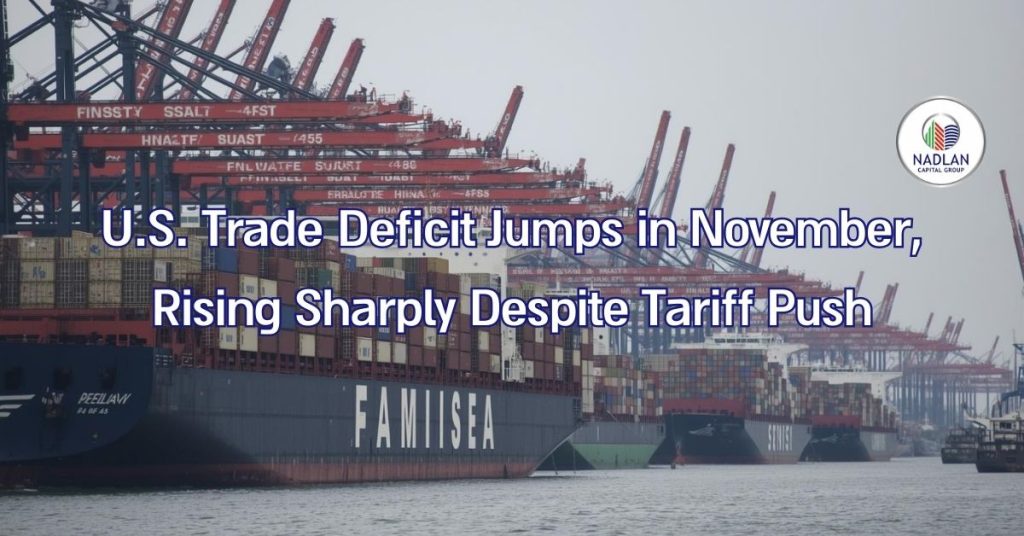
U S Trade Deficit Jumps in November, Rising Sharply Despite Tariff Push


According to new data from the U.S. Census Bureau, the trade deficit surged to $56.8 billion in November, a 94.6% jump from October. Just one month earlier, the deficit had fallen to its lowest level since early 2009, making the rebound especially striking.
The largest driver of the increase came from Europe. The U.S. goods deficit with the European Union widened by $8.2 billion in a single month, accounting for roughly one-third of the total rise. In contrast, the deficit with China narrowed slightly, falling by about $1 billion to $13.9 billion. While U.S.–China trade tensions have cooled compared with prior years, Europe has emerged as a growing source of imbalance.
Looking beyond one month, the broader trend is also moving in the wrong direction. Through November, the total U.S. trade deficit reached $839.5 billion, roughly 4% higher than during the same period in 2024. That suggests November’s spike wasn’t just a statistical blip, but part of a pattern of persistent trade gaps.
This data complicates the administration’s tariff strategy. President Donald Trump has repeatedly argued that tariffs would shrink trade deficits, and earlier in 2025, “reciprocal tariffs” were explicitly tied to bilateral trade imbalances. But as the year progressed, that approach softened. By August, the White House reached a framework agreement with the EU that capped most European tariffs at 15%, aiming to stabilize transatlantic trade rather than aggressively rebalance it.
November’s numbers highlight the limits of tariffs as a standalone tool. Trade flows are shaped not just by duties, but by consumer demand, global supply chains, currency movements, and economic growth. When U.S. demand is strong, imports can rise quickly—even under higher tariff regimes.
For now, the takeaway is clear: the U.S. trade deficit remains large, uneven across trading partners, and highly sensitive to global conditions. That raises ongoing questions about whether tariff-based policies can meaningfully reshape trade balances over the long term—or whether deeper structural forces continue to dominate the outcome.
For direct financing consultations or mortgage options for you visit 👉 Nadlan Capital Group. Contact us today for a tailored consultation, where our expert advice turns potential into profitable reality.
🔍 If you’re looking to get the best possible mortgage in the U.S. for Foreign Nationals and Americans, and want to run an auction between more than 3,000+ lenders, click here👇
Creative Financing – Nadlan Capital Financing for Foreign Nationals & Americans
Continue reading on our site:
#TradeDeficit
#GlobalEconomy
#Tariffs
#USTrade
#EconomicPolicy

























Responses