
Mortgage Rates Hit 3-Year Low Ahead of Fed Decision: What This Means for Borrowers


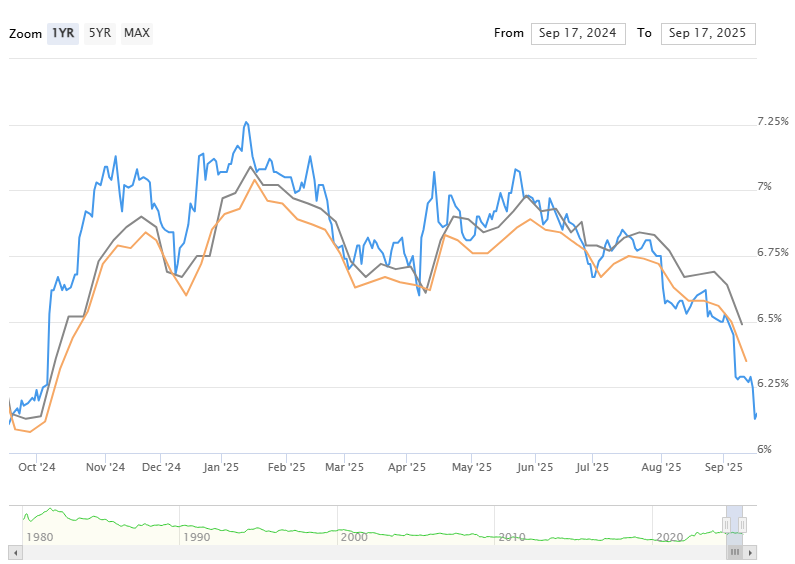
Mortgage rates have dropped to their lowest levels in nearly three years, setting the stage for a potentially volatile few days in the mortgage market. The average rate for a 30-year fixed mortgage fell 12 basis points on Tuesday, reaching 6.13%, according to Mortgage News Daily. This marks the lowest level since late 2022 and follows a broader trend of declining rates in the lead-up to the Federal Reserve’s anticipated rate cut this week.
Why Are Rates Falling?
The sharp drop in mortgage rates is largely attributed to investor behavior in the mortgage-backed securities (MBS) market, as they anticipate the Fed’s move to reduce the federal funds rate. This is a familiar pattern, as mortgage rates typically react to market expectations ahead of Fed meetings. The drop in rates comes just ahead of a highly anticipated Fed decision, with a 100% probability of at least a 25 basis point cut.
Matthew Graham, COO of Mortgage News Daily, pointed out that the current scenario mirrors what happened in September 2024, when rates also dropped in anticipation of a Fed rate cut. Interestingly, despite the rate cut that year, mortgage rates paradoxically increased shortly after the Fed’s announcement. “This time, we could see a similar outcome, but it’s by no means guaranteed,” Graham explained.
Historical Context: Will the Fed Cut Affect Long-Term Rates?
The expectation of the Fed’s rate cut has sparked discussion about its potential long-term effects. Willy Walker, CEO of commercial real estate firm Walker & Dunlop, explained that Fed rate cuts tend to have different effects depending on whether they occur during a recession. “If the Fed cuts rates during a recessionary period, long-term rates tend to fall, especially on the 10-year and 5-year Treasury bonds,” said Walker. “However, in a non-recessionary environment, like the current one, the impact on long-term rates tends to be less significant.”
Walker added that, despite the expected rate cuts, he does not anticipate a major shift in long-term mortgage rates. “Even with a 50 basis point cut in the short-term rates, I don’t see much impact on the long end of the curve,” he said. He further speculated that after the Fed announces its rate cut, there could be a sell-off in the 10-year Treasury bonds, causing rates to rise slightly in the weeks that follow.
A Paradox of Rates: Buying on the Rumor, Selling on the News
Historically, market participants have often acted on anticipation of economic news, buying assets on the rumor of favorable news and then selling once the actual news is released. Walker hinted that we could see a similar trend following the Fed’s announcement. “There’s a good chance people might buy on the rumor and sell on the news,” he noted, indicating that mortgage rates could experience a slight rise after the Fed’s rate cut is confirmed.
Looking Ahead: What Borrowers Can Expect
For now, borrowers have a window of opportunity with mortgage rates at their lowest levels in nearly three years. Those looking to refinance or purchase homes may find this to be an ideal time to lock in favorable terms. However, as we’ve seen in the past, rates can quickly shift in response to the Fed’s actions and broader economic trends.
The next few weeks will be critical for the mortgage market, with the Federal Reserve’s actions likely influencing rates and lending conditions. While the anticipated rate cut may provide immediate relief for borrowers, it’s important to stay informed about potential shifts in the market, as the long-term impact on mortgage rates remains uncertain.
In conclusion, while the drop in mortgage rates is a welcome sign for many homeowners, it’s important to remember that market reactions to the Fed’s decisions can be unpredictable. Borrowers should take advantage of current low rates but also be prepared for possible volatility in the near future. For direct financing consultations or mortgage options for you visit 👉 Nadlan Capital Group.






















Responses